



By Calvin Realty
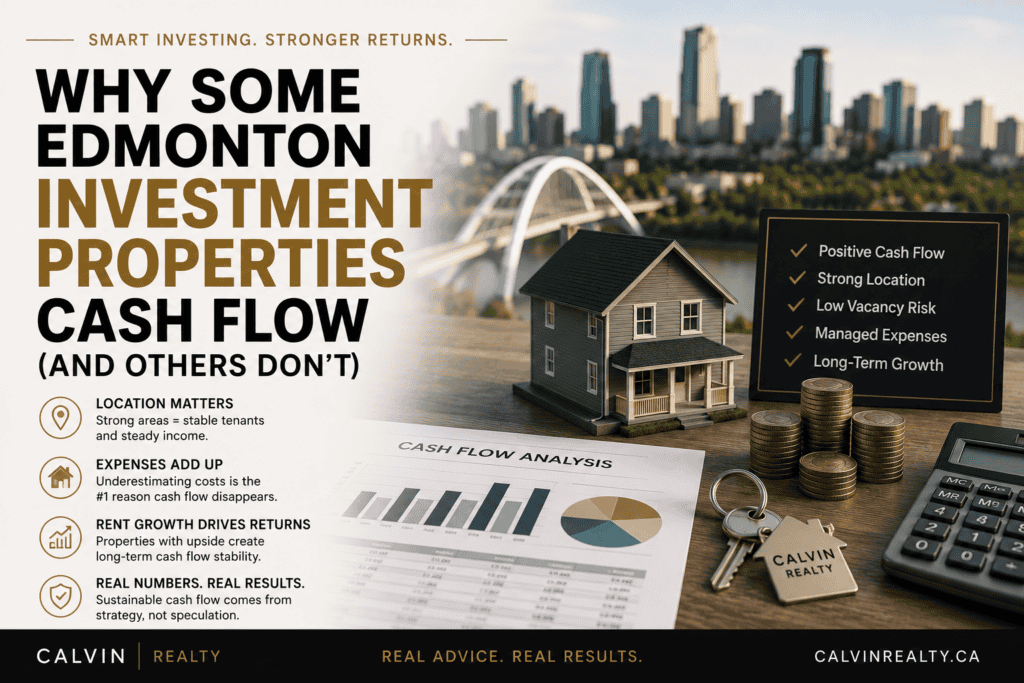
As we discuss in our guide Investment real estate, one of the biggest misconceptions investors have is assuming cash flow is simply the difference between rent and mortgage payments.
On paper, many Edmonton investment properties can be made to “look” profitable.
In reality, far fewer actually perform well long term.
Because sustainable cash flow isn’t created by simple math.
It’s created by the quality and stability behind the numbers.
And that’s where many investors quietly get caught off guard.
Why Surface-Level Deal Analysis Creates Problems

A surprisingly large number of investors evaluate properties using a very basic formula:
- estimate the rent
- subtract mortgage payments
- estimate expenses
- hope there’s money left over
If the spreadsheet shows positive cash flow, the property gets labeled “a good deal.”
But that approach often ignores the variables that actually determine long-term performance.
Things like:
- vacancy risk
- tenant turnover
- maintenance variability
- capital expenditures
- management intensity
- neighborhood stability
- and future rental demand
Those factors don’t always appear immediately.
But over time, they become the difference between:
- a property that steadily performs
- and one that constantly drains time, money, and energy
In Edmonton, Location Impacts More Than Appreciation
One of the biggest mistakes newer investors make is viewing location strictly through the lens of appreciation.
But in Edmonton, location heavily impacts cash flow stability too.
A property in a stronger rental area typically experiences:
- more consistent tenant demand
- lower vacancy
- stronger rent resilience
- and better long-term tenant quality
Meanwhile, properties in weaker locations often face:
- longer vacancy periods
- more tenant turnover
- greater rent sensitivity
- and higher operational stress
Even when two properties initially appear similar financially, the long-term experience can look completely different.
That’s why strong investors don’t just ask:
“What rents for more?”
They ask:
“How stable is the demand behind those rents?”
Different Property Types Create Different Outcomes
One of the reasons real estate investing becomes complicated is because every property type behaves differently.
In Edmonton:
- single-family homes often provide stronger tenant stability but thinner cash flow margins
- suited homes can increase revenue significantly while also increasing management complexity
- duplexes and small multifamily properties may improve scalability but require stronger operational systems
- condos can offer lower entry points but introduce condo fees and board-related variables
None of these property types are universally “best.”
The right investment depends on:
- your goals
- your risk tolerance
- your management capacity
- your financing strategy
- and your long-term plan
The strongest portfolios are usually built around alignment — not hype.
Expenses Are Almost Always Underestimated
This is where many investment properties quietly fail.
Especially early on.
Newer investors often underestimate:
- maintenance costs
- capital expenditures
- turnover expenses
- insurance increases
- vacancy periods
- and the true cost of self-management
A property may appear profitable during the first few months simply because major costs haven’t appeared yet.
But eventually:
- furnaces fail
- roofs age
- appliances break
- tenants move out
- and unexpected repairs happen
Strong investors don’t pretend those costs won’t exist.
They build those realities into their analysis from the beginning.
Because realistic underwriting creates sustainable investing.
Cash Flow Is Not Static
Another important misconception is assuming cash flow stays fixed forever.
It doesn’t.
Strong investment properties often improve over time because they:
- support future rent growth
- allow operational improvements
- sit in strengthening areas
- or create opportunities for value-add renovations
This is especially important in Edmonton right now.
Some neighborhoods are experiencing:
- increasing investor activity
- infrastructure improvements
- stronger rental demand
- and long-term redevelopment momentum
Others remain relatively flat.
Recognizing those trends early is where experienced investors often gain an edge.
The Best Investment Properties Usually Feel Boring
This is one of the more underrated realities in real estate investing.
The properties that perform best long term are not always the most exciting ones.
Often, the strongest deals are:
- operationally stable
- easy to rent
- located in consistent areas
- financially predictable
- and sustainable over long periods of time
Meanwhile, highly “exciting” deals sometimes create the most volatility.
Strong investing is usually less about chasing flashy opportunities — and more about building durable, repeatable performance.
Final Thoughts
Understanding why some Edmonton investment properties cash flow while others quietly struggle has very little to do with simple spreadsheets.
The real difference comes down to:
- location quality
- operational stability
- tenant demand
- expense realism
- and long-term sustainability
Because sustainable cash flow isn’t about making numbers work temporarily.
It’s about owning properties that continue performing even after the unexpected costs, market shifts, and operational realities begin showing up.
And in real estate investing, that’s what actually matters.